
Hanbat National University
📡 AI-enabled Integrated Sensing and Communication (ISAC)
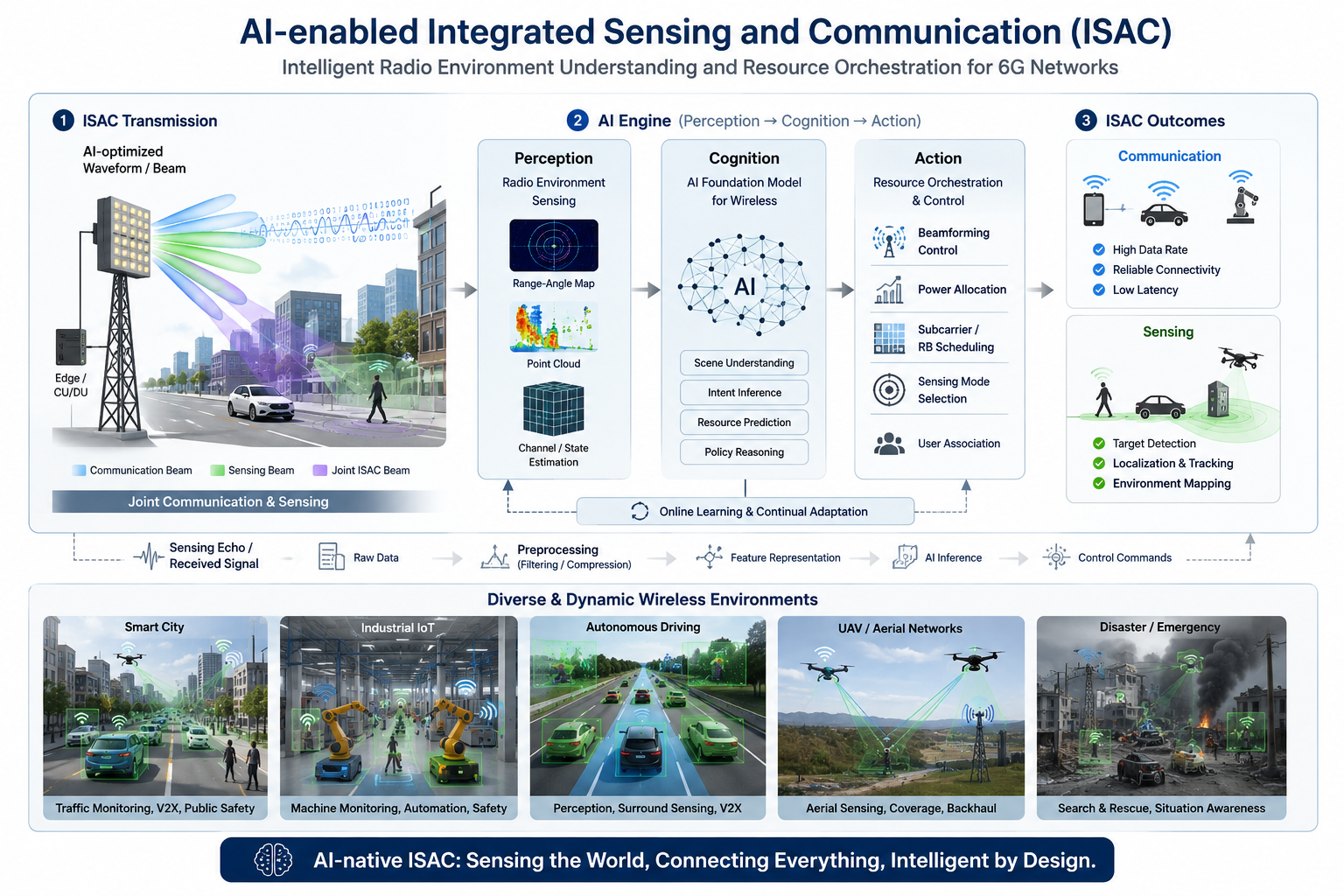
Our lab explores AI-enabled integrated approaches that unify physical-layer sensing, high-speed communication, and distributed computation. By developing novel PHY/MAC algorithms and scalable protocols, we aim to achieve systems that can dynamically adapt to their environment, optimize resource utilization, and enable seamless interaction among connected intelligent devices.
Related Publications:
- Structure-Aware Affine Frequency Division Multiplexing with Residual Dispersion Calibration for Wideband Pinching-Antenna ISAC, In preparation
- Vision-Language Model Driven Beam Selection for Multi-RIS-Aided MU-MIMO ISAC Systems, In preparation
- Beamforming Optimization and Feedback Allocation for Multistatic Multi-User MIMO-OFDM ISAC Systems, To be submitted
🤖 Multimodal Large Language Model (MLLM) for Wireless Communication Networks
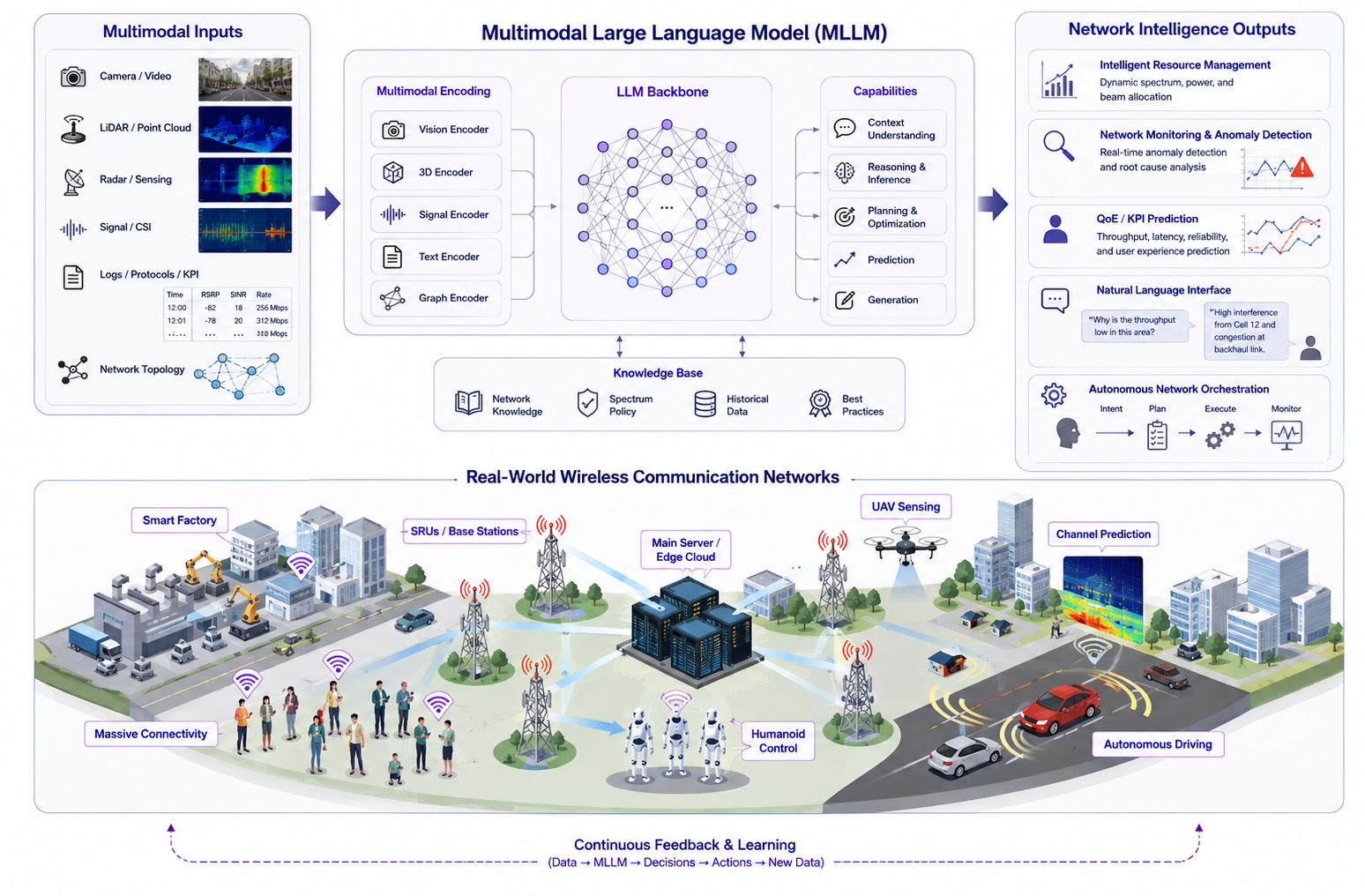
Our lab explores Multimodal Large Language Models (MLLMs) as intelligent orchestrators for next-generation wireless communication networks. By jointly reasoning over heterogeneous inputs—channel measurements, sensing signals, user context, and natural-language intents—MLLMs can interpret complex network states, predict resource demands, and autonomously generate control strategies across multiple layers of the wireless stack.
Related Publications:
- Multimodal Large Language Model-guided Constrained Optimization for RAN Intelligent Control, Submitted to IEEE Journal on Selected Areas in Communications (JSAC)
- Robust Transmission of Punctured Text with Large Language Model-based Recovery, IEEE Transactions on Vehicular Technology (TVT), vol. 75, no. 1, pp. 1737-1742, Jan. 2026
- Large Multimodal Model-Empowered Task-Oriented Autonomous Communications: Design Methodology and Implementation Challenges, IEEE Vehicular Technology Magazine (VTM), accepted
📶 AI-aided Wireless Communication
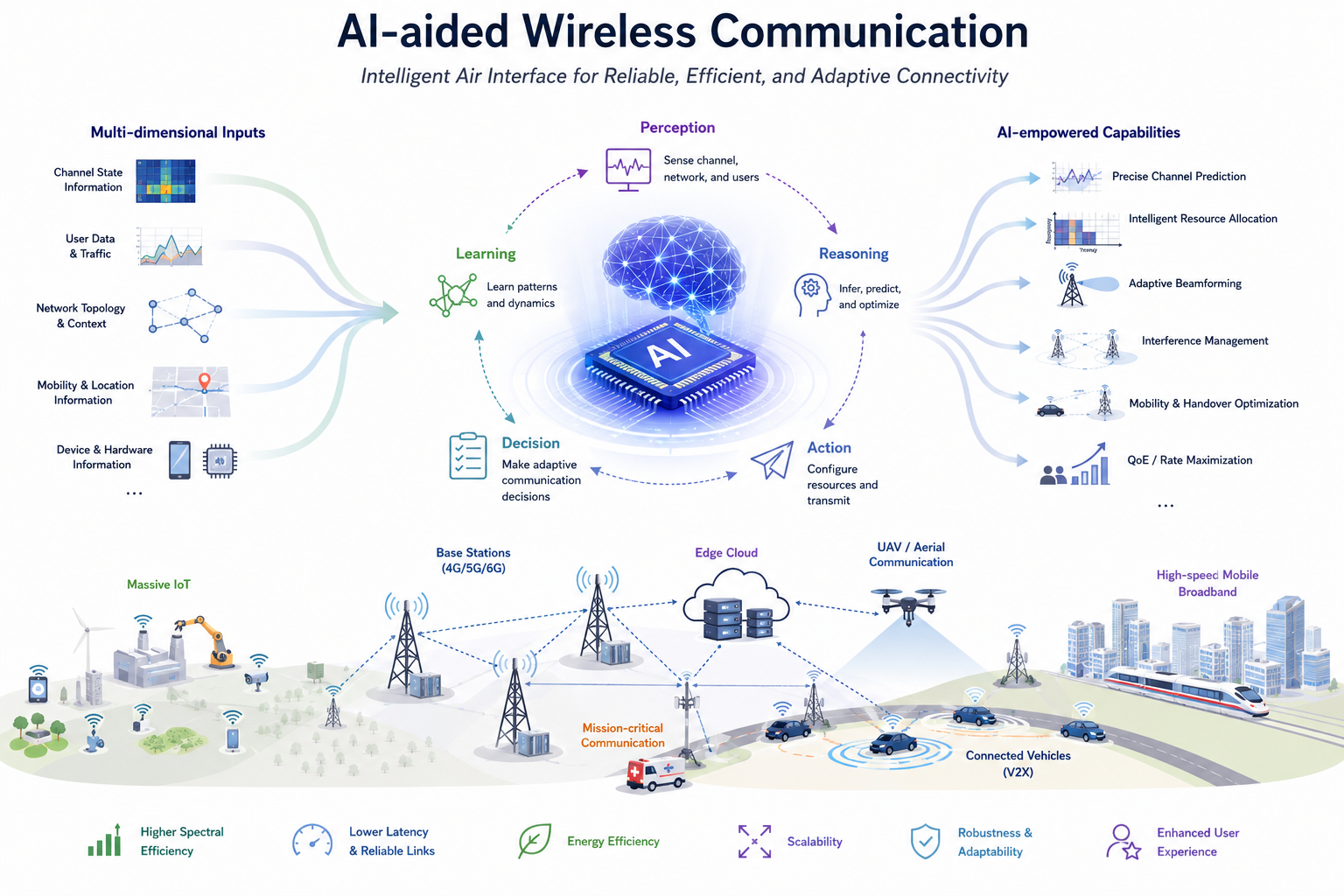
Our research focuses on making artificial intelligence a central component in the design, optimization, and management of next-generation wireless networks. By leveraging machine learning and large-scale AI models, we aim to build systems that can sense their environment, anticipate traffic and resource demands, and adapt communication strategies in real time. Through this approach, our lab is working to create wireless technologies that are not only more efficient, but also more resilient and scalable across all layers of the wireless stack.
Related Publications:
- Group-wise Semantic Splitting Multiple Access for Multi-User Semantic Communication, IEEE Wireless Communications Letters (WCL), accepted
- LOAD: Load-Aware Dual-Price GNN Routing for Cross-Layer Secure Relay in Multi-Layer NTN, Submitted to IEEE Transactions on Wireless Communications (TWC)
- MROP: Mask-Region Optimized Purification for Backdoor Defense in Deep JSCC, Submitted to IEEE Transactions on Vehicular Technology (TVT)
🎯 Deep Learning-based Sensing
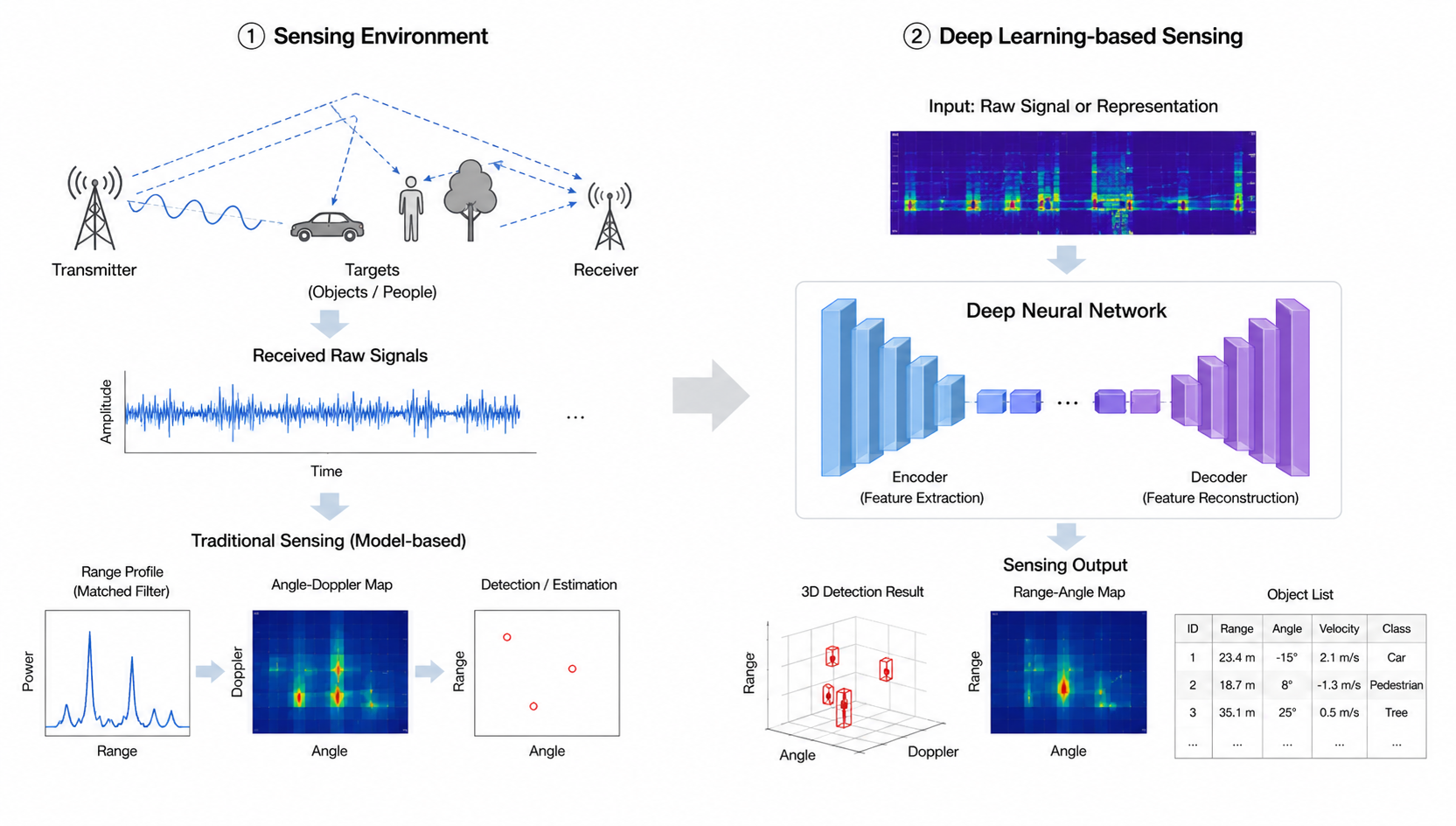
Deep Learning-based Sensing is reshaping the way wireless systems interact with the world. Instead of relying on handcrafted features or rigid signal models, deep neural networks can automatically discover patterns hidden in complex wireless data. This capability enables wireless signals to serve as powerful sensors, capturing information about human behavior, device activity, and environmental changes. By fusing communication with perception, deep learning-based sensing opens new opportunities for building adaptive, intelligent, and human-aware wireless technologies.
Related Publications:
- ALERT Open Dataset and Input-Size-Agnostic Vision Transformer for Driver Activity Recognition Using IR-UWB, IEEE Access, vol. 14, pp. 28654-28674, 2026
- Leveraging Multiple PRF Radar for Target Detection and Sea Clutter Suppression with Deep Learning Network, Proc. International Conference on ICT Convergence (ICTC)